Don't Speak for the Dead or My Breakup Letter to RGG
Me wrestling with digital necromancy.
Stay tuned to the end to see a silly video about GTA6.
I never knew my mother's full life until her funeral.
We aren't the same person to all people. Your spouse sees you as a partner and the love of their life, while your friends see you as the comic relief of the group. Meanwhile, your coworkers rely on you as a dependable fixture. Your children and pets gaze up at you as a provider, yet your grandparents and parents will never stop looking at you as a child. And as for your enemies and opps, let’s hope there aren’t many.
You can't be everything to everyone. You give different parts of yourself the different people in your life. Your work colleagues can't rely on the party animal goofball that your friends expect. Walt Whitman wrestled with this in his poem, Song of Myself. And according to him, we contain multitudes.
Working at a teaching hospital, many aspiring nurses looked up to my mom. They regard her as a mentor, a wise woman with a mountain of experience. I never saw my mom like that. But the love and adoration we exchanged differed from that between her and her students.
When someone looks me straight in the eye and tells me they know what my mom would've wanted or said, I clench my fist and focus my willpower to not clocking them on the jaw. How dare they put words in her mouth? I am her son, and I only understand a fragment of her life. How dare you put words in her mouth now that she can no longer speak?
Speaking for the dead is, at its best, rude, and at its worst, blasphemous. You are puppeteering the deceased with your own words. A person contains multitudes. They live fuller lives and have more internality than we can ever know. Take a moment to look within yourself, wading through your torrents of thoughts, fighting internal struggles. Can you definitively say people can speak for you?
Depends on who you ask, I might either be a new fan of the Yakuza series or a fake fan. I started with Yakuza 0. Though I dabbled with Yakuza 4 on the PlayStation 3; I found it impenetrable since I have yet to play the first three. However, Yakuza 0, the best game in the series, gave me a starting point. After that, I devoured all the Yakuza, or Like a Dragon, games.
Like many fans, I got hyped for Sega and RGG to announce Stranger than Heaven. We don't get too many stories that take place in Japan in the early and mid-twentieth century. Around the time of the announcement, I saw Godzilla Minus One. Plus, I've read a few of Osamu Dazai's books, including Junji Ito's interpretation of No Longer Human. Which, by the way, is an insane retelling of the classic.
I was beyond hyped and excited.
The addition of Snoop Dogg baffled me. While weird, it's not a dealbreaker. Given RGG’s track record of washing away Japanese actors convicted of drug offenses, I found the inclusion of Snoop Dogg hilarious. Then again, Snoop's not Japanese.
However, the appearance of Tupac Tiger Dropped me right in the chest. Dressed in a kimono, he donned his bandana.
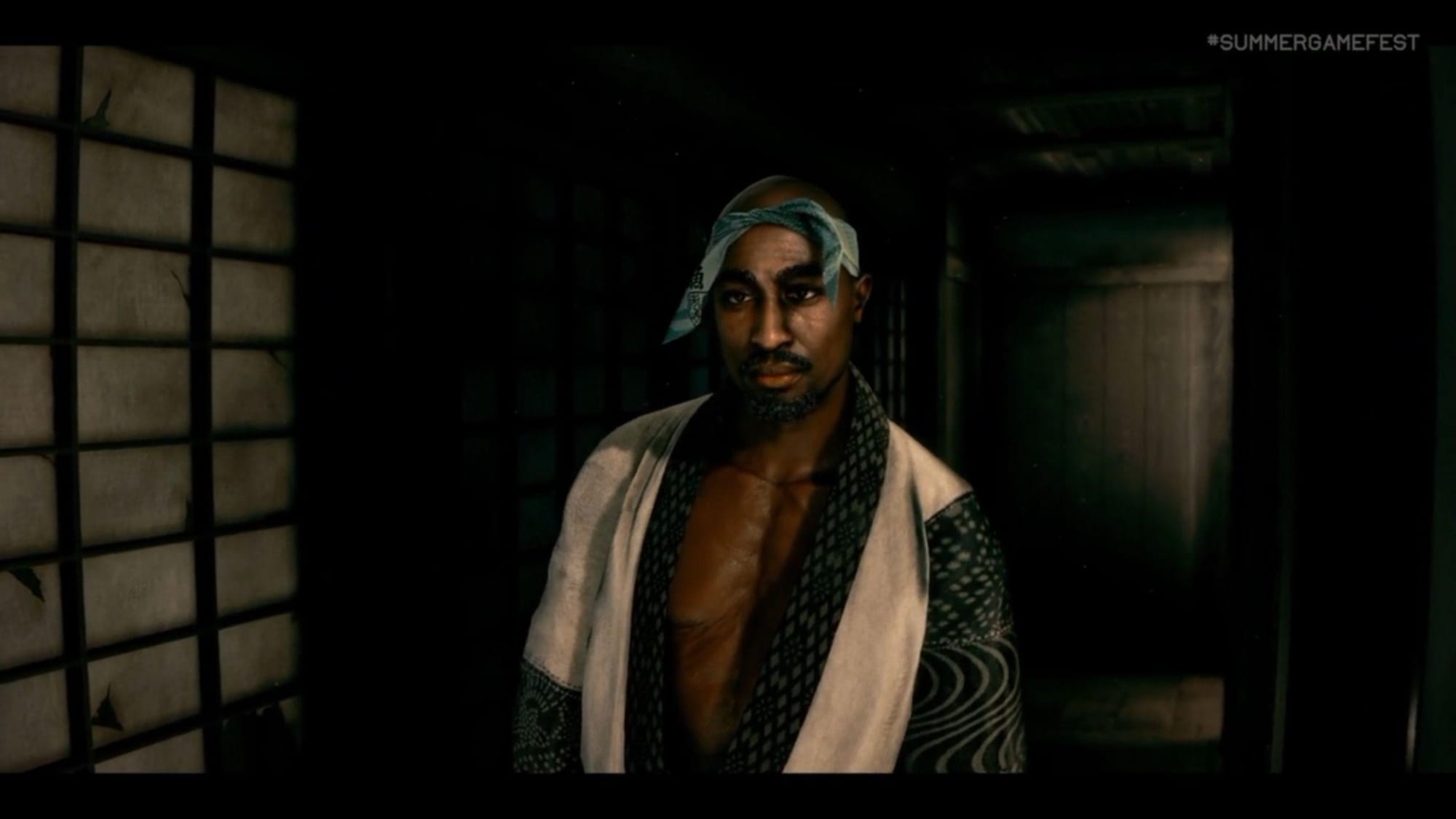
The reaction during Summer Game Fest turned my confusion into outrage. The crowd started cheering. How are they okay with this? I thought. Then again, plants filled the theater, paid to clap at every single announcement.
How is this even possible? Who is this even for? I understand that the Yakuza audience skewed older, but was this a ploy to sell more copies? Over a decade ago, Tupac appeared as a hologram at Coachella. I wasn't alone in despising that. Conversation about it bubbled through the internet.
Snoop said that he worked with Tupac's estate, though the estate is not his family. The contention between his likeness aside, Tupac had no say in being in this game. He died long before the release of the PlayStation 2, the console that played the first Yakuza game. In his time, it was just the Super Nintendo and the Sega Genesis.
In the underrated show, the Critic, the Ted Turner analog, Duke Phillips, released Phillips Vision. With this technology, Duke used computers to revive dead actors and rewrite endings. When a reporter asked Duke what the dead actors would think about using their likeness, he played a video of Edward G. Robinson signing his rights away. This great gag poked fun at the digital necromancy of the late 90s, where Fred Astaire, who died only a decade prior, danced with a vacuum cleaner in a commercial. What a prescient joke from a late 90s animated show.
In Haitian mythology, a sorcerer would reanimate a corpse into a zombie to have them work against their will. The comes from the loss of autonomy as the once-living find themselves as forced puppets. In many fantasy worlds, people regard necromancy as a forbidden art. We've written bringing back the dead as blasphemy into our own internal mythology.
Back to reality, it's not healthy to keep bringing back the dead. It prevents us from having closure. While we mourn and remember, life is for the living. Though no longer with us, letting go and moving on is not forgetting. In fact, we should honor those who passed for what they've done while they are alive, when they still have freedom and autonomy.
In the book Sum: Forth Tales from the Afterlives, neuroscientist David Eagleman tells us the story of a purgatory where souls linger, unable to go to heaven, until the living had forgotten them. These spirits wander, unable to rest, until no one on earth remembers their names. While some wandered through purgatory for a generation or two, many find themselves trapped as people continue to whisper their names.
We owe it to the dead to give them rest and celebrate their accomplishments during their lives. We also owe it to them not to put words into their mouths. Life is for the living, death is for resting.
What GTA VI news sounds like to a non-gamer.
Comments or questions? Hit me up on Bluesky.